
Across jurisdictions, mental health and substance use health leaders are grappling with many of the same challenges—from access and workforce pressures to implementation and system change. Recent conversations with leaders across systems reveal shared questions, even as the contexts and resources differ.

Nearly 30 per cent of Canadian adults reported a mental health condition in 2023, up from 20 per cent in 2016 (CIHI). Meanwhile, access to mental health and substance use health services remains a challenge, with workforce capacity struggling to meet rising demand.
This challenge is not unique to Canada.
A recent international study led by researchers from the University of British Columbia and Harvard University found that only 6.9 per cent of people living with a mental health or substance use disorder receive effective treatment—just seven out of every 100 people worldwide.
Despite decades of innovation, investment, and reform, a considerable gap remains between need and care.
Different Systems, Similar Questions
Over the past several months, we have had the opportunity to connect with community, provincial/territorial, national, and international mental health and wellbeing leaders through implementation partnerships, sector events, and the Global Leadership Exchange (GLE). The systems represented were often very different, operating within distinct funding models, policy environments, and organizational structures.
Yet the conversations were remarkably similar.
Across jurisdictions, leaders continue to wrestle with many of the same questions:
- How do we improve access within existing resources?
- How do we build stronger connections and pathways between services and supports?
- How do we support a workforce facing increasing pressure and complexity?
- How do we move beyond successful pilot projects and implement change at scale?
- How do we sustain progress when priorities shift, resources are constrained, and new challenges emerge?
These questions are surfacing across countries with very different healthcare systems, funding models, and approaches to care.
If the challenges are similar, are there lessons that can be shared across systems?
“Access is not only about getting more people into services. It is about helping people connect with support that is timely, appropriate, and meaningful to them.”
Expanding Pathways to Care
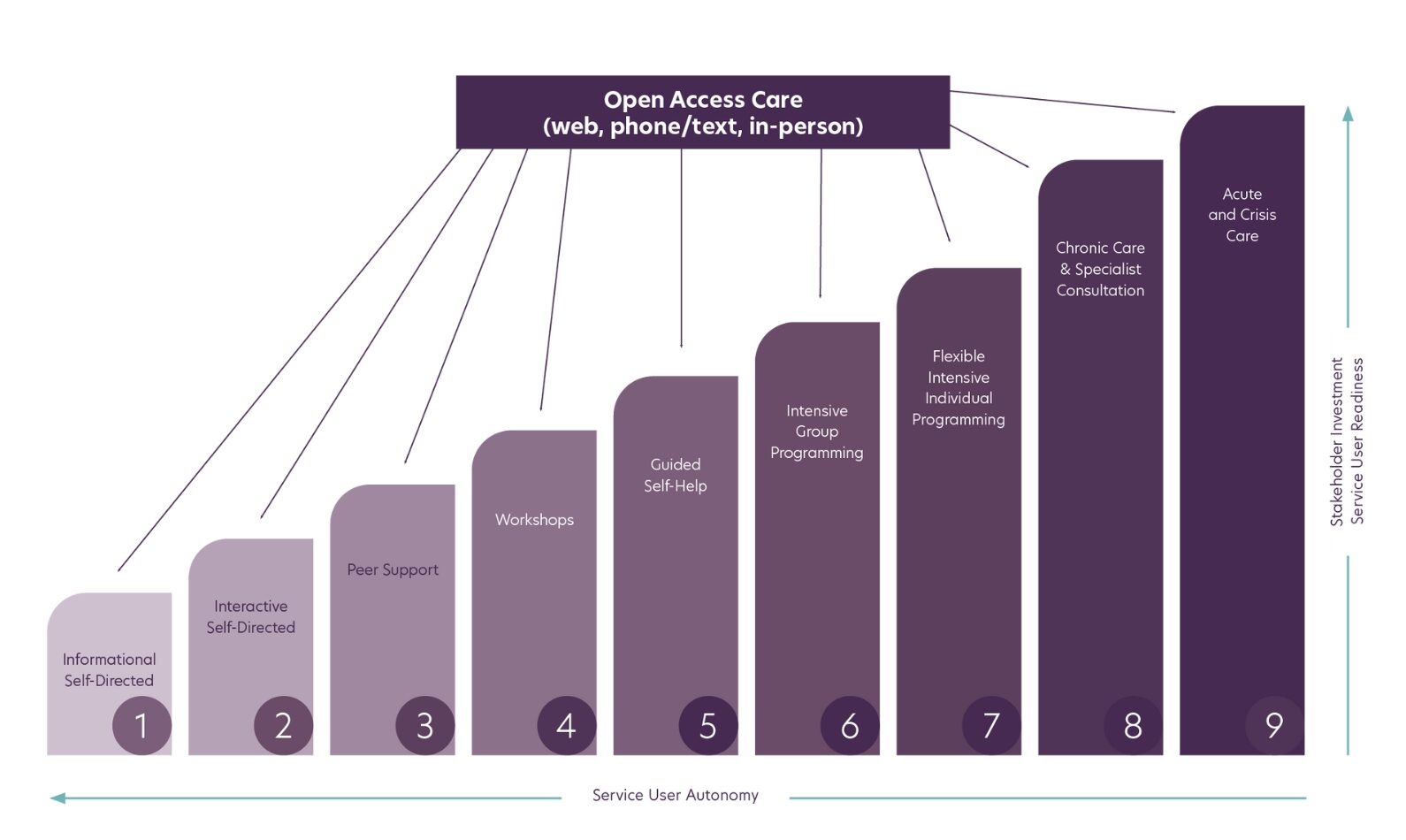
There is growing recognition that improving access and outcomes is not simply about adding more services. It is about creating systems that are more connected, responsive, and flexible.
Conventional standards of care remain essential. Counselling, psychotherapy, psychiatry, crisis response, and inpatient services all play a critical role. At the same time, many organizations are exploring how these services can be complemented and system outcomes improved by additional support pathways, from peer support, self-directed resources and brief interventions, to workplace supports, digital tools, and community-based services.
The goal is not to replace one approach with another; it is to recognize that people experience challenges differently and may need different types of support at different points in their lives.
This theme surfaced repeatedly in conversations with leaders from Canada and abroad. While the language varied, the underlying idea was often the same: access is not only about getting more people into services. It is about helping people connect with support that is timely, appropriate, and meaningful to them.
The Impact of Implementation Support
Another theme that emerged was the growing importance of implementation.
Sectors have no shortage of innovative ideas or frameworks for change. Many leaders struggle to turn these into effective and practical operations and sustain them over time.
The challenge is increasingly about creating the conditions that allow change to take hold, rather than knowing what needs to change.
This may be why conversations about workforce wellbeing, partnerships, leadership, and implementation are becoming more prominent. These elements are increasingly recognized as foundational to improving outcomes.
What We’re Learning
The access gap facing mental health and substance use health systems remains significant, and there are no simple solutions. However, conversations with leaders across jurisdictions suggest that progress doesn’t just rely on the services available. It also depends on how systems are organized and connected, how easily people can navigate supports, and how effectively they enable implementation, workforce capacity, collaboration, and adaptation.
Although the details vary from one community to another, many of the questions—and many of the lessons—are remarkably consistent. As demand continues to grow, there is value in paying attention to these shared experiences and considering how they might be adapted to local contexts.
For more information on how we co-design and implement innovative, flexible and sustainable mental health and substance use health care systems and service delivery, contact our implementation experts to explore your opportunities.
Sources
Canadian Institute for Health Information (CIHI). Canada’s Mental Health and Substance Use Workforce. Ottawa, ON: CIHI. Available at: https://www.cihi.ca/en/canadas-mental-health-and-substance-use-workforce
Pozuelo, J. R., Vigo, D. V., Kazdin, A. E., Harris, M. G., Stein, D. J., Viana, M. C., Hwang, I., Kessler, T. L., Manoukian, S. M., Sampson, N. A., et al., & World Mental Health Survey Collaborators. (2025). Predictors and barriers to minimally adequate treatment among treated individuals with mental disorders: Results from the World Mental Health Surveys. International Journal of Mental Health Systems, 19(1), 34. https://doi.org/10.1186/s13033-025-00686-6
World Health Organization. World Mental Health Report: Transforming Mental Health for All. Geneva: World Health Organization. Available at: https://www.who.int/publications/i/item/9789240049338
World Health Organization. Mental Health Atlas. Geneva: World Health Organization. Available at: https://www.who.int/teams/mental-health-and-substance-use/data-research/mental-health-atlas